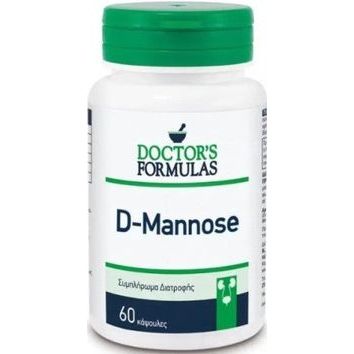

Doctor's Formulas D-Mannose Dietary Supplement For The Normal Function Of The Urinary System 30 Capsules Dietary Supplement, D-Mannose Formula PHYSIOLOGICAL FUNCTION OF THE URINARY SYSTEM The D - Mannose formula is a dietary supplement containing the monosaccharide D-mannose. What is D-Mannose? D-mannose is a simple sugar that has a special contribution to metabolism, through its role in the glycosylation of certain proteins. D-mannose is rapidly absorbed and reaches the peripheral organs in about 30 minutes and is then excreted by the urinary system. It cannot be converted into glycogen, therefore, it is not stored in the body. It binds to lectins and thus prevents the adhesion of pathogenic organisms to the walls of the bladder. Mechanism of Action Its mechanism of action is expressed through inhibition of adhesion of the surface protein FimH. By direct binding of FimH to D-mannose that is associated with a carrier protein, which is responsible for the specificity of the receptor. The 1st step of adhesion involves the mannose-sensitive binding of FimH to the epithelium. The bladder wall is coated with various mannose-glycosylated proteins, such as Tamm-Horsfall protein (THP) that directly interferes with the adhesion of microbes to the mucosa. Tamm-Horsfall protein (THP) can bind to E. Coli with a specific bond, which can be inhibited by exogenous D-mannose. By inhibiting the adhesion of microbes to the urinary tract epithelium, D-mannose mimics the function of the urinary tract epithelial barrier. Dosage 1 - 2 capsules per day The role of D-Mannose in the Physiological Function of the Urinary System What is D-Mannose? D-mannose is a simple sugar, which has a particular contribution to metabolism, through its role in the glycosylation of certain proteins. D-mannose is rapidly absorbed and reaches the peripheral organs in about 30 minutes and is then excreted by the urinary system. It cannot be converted into glycogen, therefore, it is not stored in the body. Even the long-term use of D-mannose, at concentrations up to 20%, did not show any side effects on human metabolism. Mechanism of Action Its mechanism of action is expressed through inhibition of the adhesion of E. Coli to uroepithelial cells through the surface protein FimH. By the direct binding of FimH to D-mannose associated with a carrier protein, which is responsible for the specificity of the receptor. In vitro studies have identified the specific lectin for mannose on the surface of adherent E. Coli strains. There are other in vitro studies that have clarified the mechanism of adhesion. D-mannose occupies a dominant position in the receptors of bladder cells, with regard to the uropathogen E. Coli. The first step of adhesion involves the mannose-sensitive binding of FimH to the bladder epithelium. The bladder wall is coated with several mannose-glycosylated proteins, such as Tamm-Horsfall protein (THP), which directly interferes with the adhesion of microbes to the mucosa. Tamm-Horsfall protein (THP) can bind to E. coli by a specific bond, which can be inhibited by exogenous D-mannose.
1
/
of
1
Doctor's Formulas
Doctor's Formulas D-Mannose Dietary Supplement For Normal Function Of The Urinary System 30 Capsules
Doctor's Formulas D-Mannose Dietary Supplement For Normal Function Of The Urinary System 30 Capsules
Regular price
€10,75 EUR
Regular price
Sale price
€10,75 EUR
Taxes included.
Shipping calculated at checkout.
Quantity
Couldn't load pickup availability
Share